
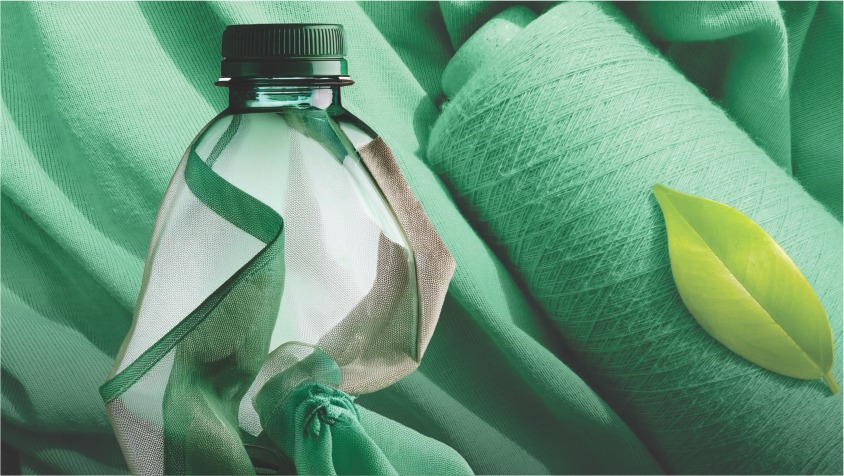
From Bottle to Better: RSWM’s Circular Textile Journey
Plastic Reborn. Fabric Reimagined. RSWM’s FibreGreen® Innovation.
When you choose a garment, you don’t see the water saved, the community supported, or the energy reduced. But those invisible choices are where sustainability lives. At RSWM, we see it as a responsibility, to create fabrics that not only feel right today, but also leave the world better for the generations after us.
The Case for PET Recycling
Plastic waste is one of the world’s biggest sustainability challenges. More than 25,000 tonnes of plastic are generated daily in India, much of it ending up in landfills and oceans. The textile sector plays a critical role in closing this loop by converting waste into usable resources.
RSWM’s Measurable Impact
At its Ringas facility near Jaipur, RSWM recycles around 1,830 million PET bottles every year, producing 51,580 MT of recycled polyester (Green Fibre®). This measurable scale makes RSWM one of the largest PET-to-fibre converters in the country.
- Bottles diverted from landfill: 1830 million annually.
- Recycled polyester produced: 51,580 MT per year.
- Carbon footprint saved: 8,00,000 MT annually.
From Bottle to Fibre: The FibreGreen® Journey
- Collection & Sorting – Disposed PET bottles are collected and cleaned.
- Flakes & Pellets – Bottles are processed into flakes, then melted into pellets.
- Recycled Fibre – Pellets are spun into recycled fibre, cut into deniers and lengths.
- Yarn & Fabric – Fibre is spun into yarns, blended with cotton or synthetics, and woven into consumer fabrics.
The result is recycled polyester that performs similarly to virgin polyester, with significantly lower resource impact.
Where FibreGreen® Goes
Recycled polyester from PET bottles is used across RSWM’s textile portfolio:
- Denim – blending rPET with cotton for sustainable jeans.
- Shirting & Fashion – lighter blends for everyday apparel.
- Uniforms & Workwear – durable fabrics with a lower footprint.
Meeting the World’s Expectations
- Circular economy – keeps plastics in use, out of landfills.
- Lower carbon & energy use – compared to virgin polyester.
- Buyer alignment – international brands demand measurable sustainability data.
RSWM’s fibre-to-fabric approach meets these expectations with scale and traceability.
Grounded in Green: The Earth Element
Under the Earth element of Panchtatva, RSWM defines its sustainability ethos as “Grounded in Green.” PET recycling into FibreGreen® is a direct expression of this principle, turning waste into a resource and keeping the planet’s balance at the core of textile innovation.
Waste. Fibre. Fashion. Future.
PET bottles are no longer waste; at RSWM, they are a raw material for the future. By recycling 1830 million bottles every year into FibreGreen® recycled polyester, RSWM delivers measurable sustainability, global relevance, and fabrics that prove responsibility can be scaled.